The Four Elements and the Four Functions (from songsouponsea)
Re-exported from songsouponsea and fixed some broken links
If you wish to untie a knot, you must first understand how it was tied."
Buddhism. Surangama Sutra
"Only after I had familiarized myself with alchemy did I realize that the unconscious is a process and that the psyche is transformed or developed by the relationship of the ego to the contents of the unconscious."
C. G. Jung; Memories, Dreams, Reflections: P. 209
Jung referred to the symbolism of eight, a motif found in Castel del Monte, as a double quaternity.
"Very frequently they (mandalas) contain a quaternity or a multiple of four, in the form of a cross, a star, a square, an octagon, etc. In alchemy, we encounter this motif in the form of quadratura circuli."
C. G. Jung, Mandala Symbolism
"A quaternity or quaternion often has a 3 + 1 structure, in that one of the terms composing it occupies an exceptional position or has a nature unlike that of the others. (For instance three of the symbols of the Evangelists are animals and that of the fourth, of St. Luke, is an angel.) This is the "Fourth," which, added to the other three, makes them "One," symbolizing totality. In analytical psychology often the "inferior" function (i.e., that function which is not at the conscious disposal of the subject) represents the 'Fourth," and its integration into consciousness is one of the major tasks of the process of individuation."
C. G. Jung; Memories, Dreams, Reflections
"The process of individuation is symbolized by the trinity archetype, while the quaternity symbolizes its goal or completed state when, through the transcendent function, integration is complete. Three is the number for egohood; four is the number for wholeness, the self ..."
The first four King Crimson albums represent a quaternity with the fourth album, Islands, occupying the exceptional position (having a nature unlike that of the others).
"the double quaternity or ogdoad stands for a totality, for something that is at once heavenly and earthly, spiritual or corporeal ..." (Jung, MC 11). The same image appears in shamanism, where the World Tree, which connects heaven and earth, has eight branches, associated with eight great gods (Jung, Phil. Tree 305).
The Pythagorean Tarot by John Opsoupos
The double quaternity is half "above" and half "below".
"Its Pythagorean interpretation is balance, completeness, heaven and earth, the four elements of the body governed by the fourfold soul, cosmic law, and natural rhythm."
The Pythagorean Tarot by John Opsopous
The "fourfold soul" refers to Jung's four psychological functions: thinking, feeling, sensation, and intuition.
"According to Jung, the Ego or self-conscious faculty has four possible fundamental ways of perceiving and interpreting reality.
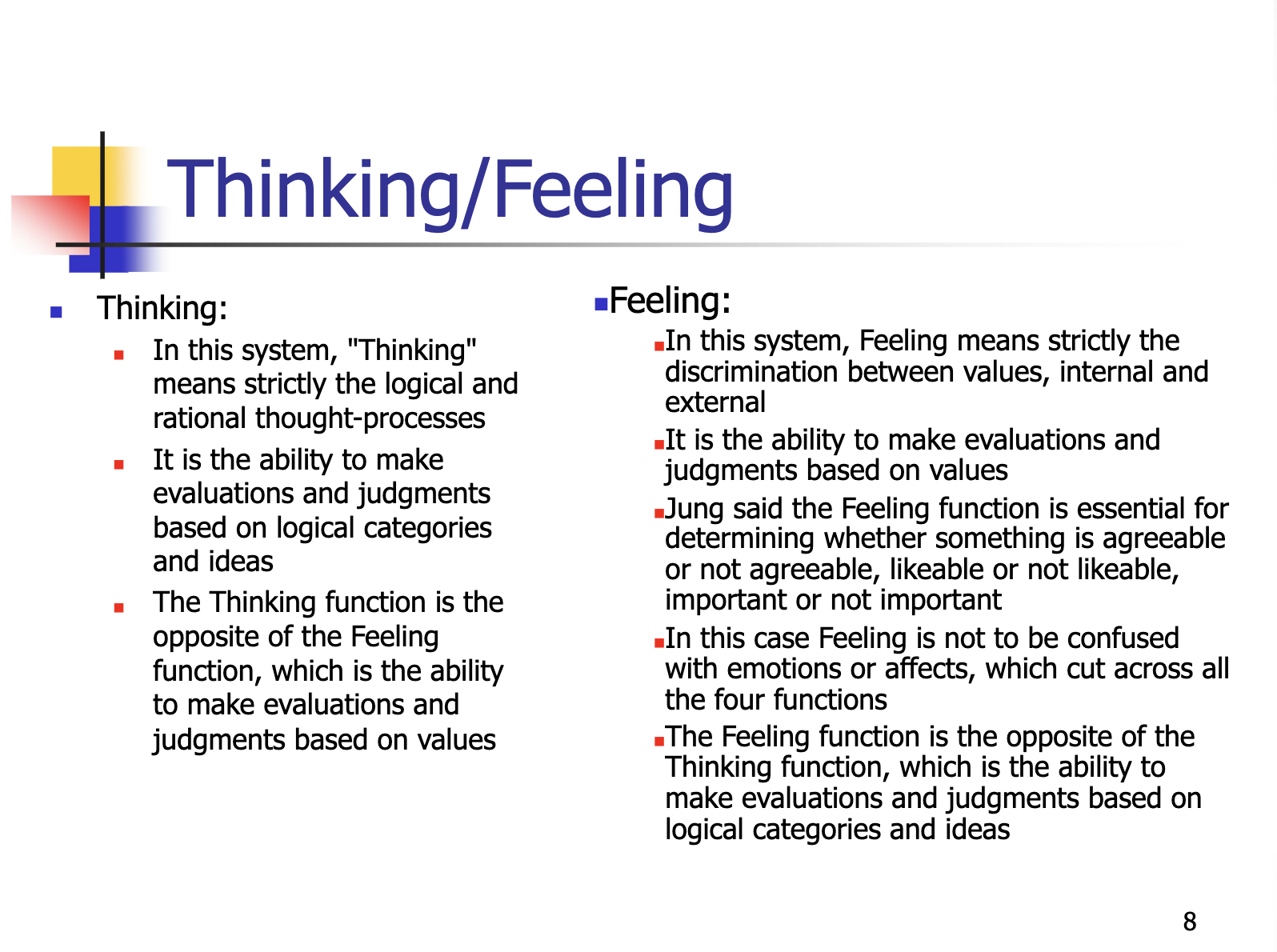
The four ways of interpreting reality are the four "ego-functions" - Sensation, Thinking, Feeling, and Intuition. These consist of two diametrically-opposed pairs. So, suggests Jung, if a person has the Thinking function (an analytical, "head"-type way of looking at the world) highly developed, the Feeling function (the empathetic, value-based "heart"-type way of looking at things) will be correspondingly undeveloped, and in fact, suppressed. The same goes for Sensation and Intuition. Sensation is orientation "outward" to physical reality, and Intuition "inward" to psychic reality.
Thus the four functions can be arranged diagrammatically as a dial, with one function in full consciousness and fully developed, another function as secondary to this, a third function, the opposite of the second, as slightly suppressed and unconscious, and the fourth, the opposite of the first, as totally unconscious."
Each of these four functions corresponds to one of the four elements and to one of the first four King Crimson albums.
According to Jungian thought, in utero, we are essentially unconscious, the four component parts of the psyche functioning as one. It is at birth that we fall into consciousness, the previously undifferentiated functions splitting into four separate entities.
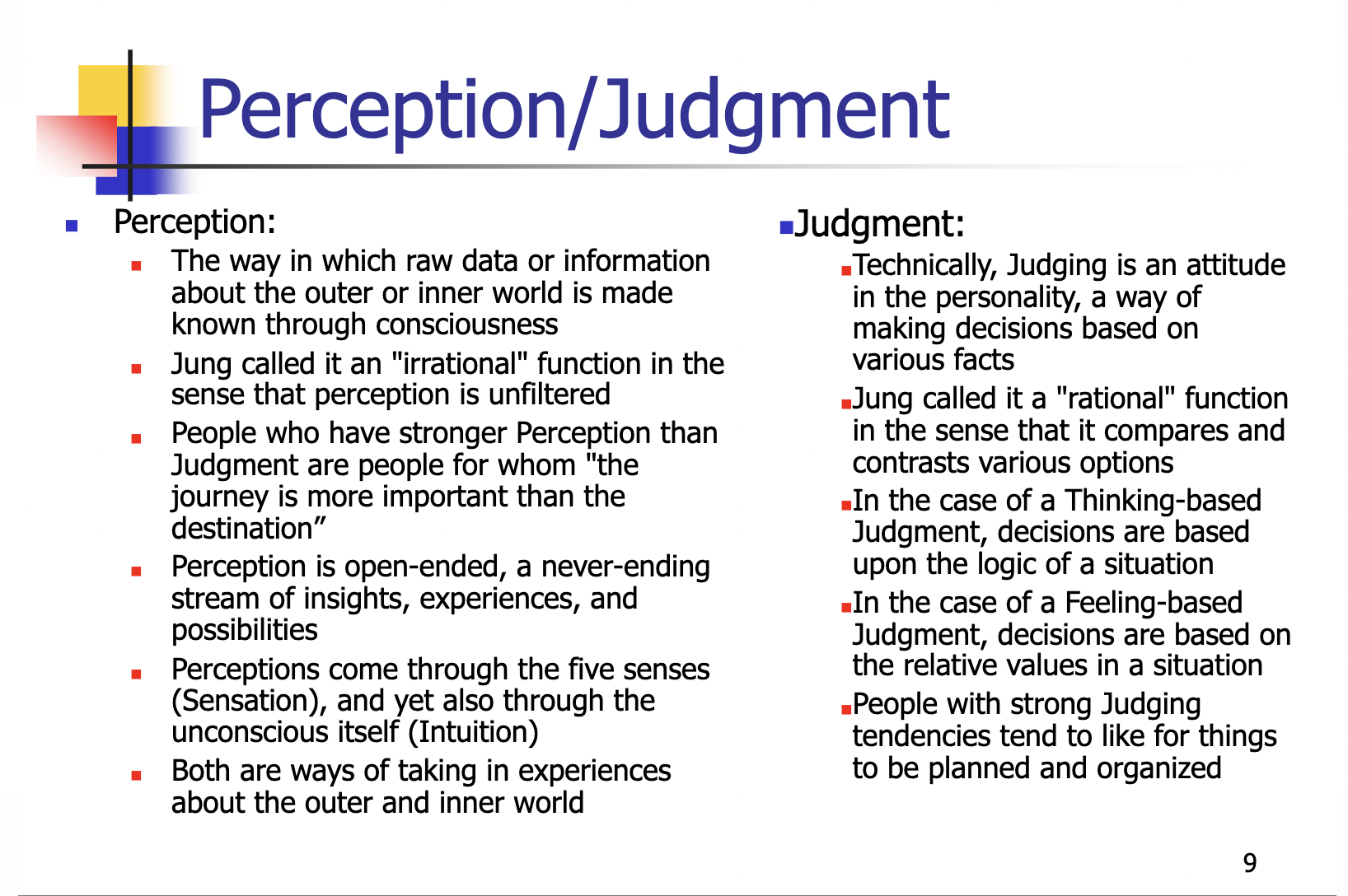
What is perhaps most significant to our discussion is the order in which these psychological functions are first experienced, or taken from the unity of all of the functions working together. Arguably, the newborn child first experiences the sensation that he is no longer one with his world (the mother) but is, instead, now separate and in the world. This sensation produces the first conscious feeling, a negative judgment. The Thinking function is differentiated when the infant becomes conscious of his separateness, a consciousness which is equivalent to the biblical Fall of Man (a fall from psychological unity). At the very moment of birth the child has made his first judgment call. Experiencing duality, his apparent separateness from all things, he has eaten from the tree of the knowledge of good and evil. As part of the psyche is now essentially "lost" in the unconscious (i.e. inaccessible to the Ego [conscious awareness] ), the "birth" of consciousness (Ego) is also a death. What was originally whole (Intuition) is now split into conscious and unconscious (Ego and Soul) and four distinct ego functions which originally functioned as one.
Below, the order in which the four functions are differentiated (taken from the unity of the whole) is listed along with each function's corresponding King Crimson album.
- Intuition (wholeness, the three other psychological functions merged as one) — Islands
- Sensation (what is perceived by the body tactilely, visually, aurally etc.) — Lizard
- Feeling (frequently considered to be emotions) — corresponds to the Wake of Poseidon in the Court of the Crimson King
- Thinking (ideas, concepts, and abstractions)
Lecture 3.4: Myers-Briggs Dr. John MacCarthy UMBC CMSC 615 Fall, 2006.
As you can see, the albums run in reverse order of their release. This is because the first function to be dealt with (by the four albums) is the last to have been differentiated (taken from the totality of the four together). As in peeling away the layers of an onion, thinking, the last function to arise as a separate entity, is the first to be dealt with in the quest for re-unity (the Self), a process which Jung referred to as individuation.
"Carl Jung concluded from his research that the process of individuation is a slow merging of the unconscious and conscious..."
The Science of Metaphysics
"Freud's view expresses an overall fear of the unconscious. He considers it a "Pandora's box," that is, if one were to open up the unconscious, a flood of evil would be let out upon the world. Jung, however, sees the unconscious as spontaneously working toward wholeness and striving toward the healing of the person. Taking a much more positive outlook, Jung sees the unconscious as a potential friend due to its tendency toward wholeness. Jung insists that the unconscious is the "matrix, the artesian well from which all creativity springs" (He: Understanding Masculine Psychology, Robert A. Johnson; pg. 14). Thus the journey through this unfamiliar world may be a valuable one, because transformation is a spontaneous motion, and if one does not inhibit the unconscious but rather removes the roadblocks, the unconscious will be helpful towards healing."
"For Jung, activating and implementing the individuation process is the highest goal in life. The ego must develop a dialogue with that primordial wisdom or meaning, that ray of divinity within us, the self, and consciously realize its vision of wholeness in our everyday activities. This is the alchemical opus, the transformation of the base metal of our unrefined psyche into spiritual gold, a process honored in worldwide myths."
The Challenge of Synchronicity
"The actual process of individuation - the conscious coming-to-terms with one's own inner center (psychic nucleus) or Self - generally begins with a wounding of the personality and the suffering that accompanies it. This initial shock amounts to a sort of 'call,' although it is not often recognized as such. On the contrary, the ego feels hampered in its will or desire and usually projects the obstruction onto something external. That is, the ego accuses God or the economic situation or the boss or the marriage partner of being responsible for whatever is hampering it ...
Or perhaps everything seems outwardly all right, but beneath the surface, a person is suffering from a deadly boredom that makes everything seem meaningless and empty. Many myths and fairy tales symbolically describe this initial stage in the process of individuation by telling of a king who has fallen ill or grown old."
C.G. Jung, Man and his Symbols
Lecture 3.4: Myers-Briggs Dr. John MacCarthy UMBC CMSC 615 Fall, 2006.